
Concept register · Concept 60 of 64 · Theme: world models and embodiment Reviewed 2026-09-01
assay · concepts · world-models-and-embodiment
World models as simulators
A world model is a learned, action-conditioned generative model of an environment, used as a simulator: roll a policy forward inside it, evaluate what happens, explore counterfactuals, and — at the frontier — let the agent act on the imagined rollout directly and re-plan when reality diverges.
established · assay: watching
7 independent sources · sighted at the Agentic AI Summit 2026 · last reviewed 2026-09-01
§1What it is
The motivation is rollout throughput
Coding and mathematics advanced quickly because they have effectively infinite cheap rollouts. Physical tasks do not, and real-world trials cap how fast a policy can learn. A learned simulator is an attempt to buy back that throughput — one group reports millions of simulations a day, another accrued the equivalent of 25 centuries of driving with zero human demonstrations.
What makes a simulator usable rather than impressive
The field is explicit about the bar: realism, controllability under counterfactual actions, per-object scene conditioning, language control, and generalization beyond the observed data distribution — because a model trained only on collected data is capped at that distribution. The strongest single demonstration of the bar being met is a production driving policy plugged into a generated world, where it drove.
The challenge aimed at everyone else
For anyone building non-physical agents the question turns around: what is your world model, and how do you know an outcome inside it predicts an outcome outside it? Simple physics is still hand-injected in the best systems and complex collisions are unmodeled, so the honest answer is that fidelity is a measured property, not an assumed one.
§2Sightings
Agentic AI Summit 2026 · 8 sightings
 #003Real World SuperintelligenceAnastasis Germanidis, Runway
 #059World Models for Physical AI SimulationSanja Fidler, University of Toronto
 #084Trustworthy Agents in the Real WorldVincent Vanhoucke, Waymo
 #023Robotics: EndgameJim Fan, NVIDIA
 #025E2E Autonomy Without ImitationWei Zhan, Applied Intuition
 #087Scaling Sidewalk Autonomy with World ModelsBolei Zhou, UCLA / Coco Robotics
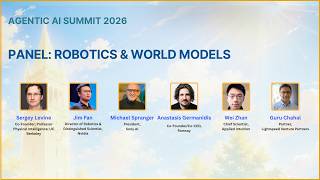 #026Panel: Robotics & World ModelsGermanidis, Fan, Levine, Spranger, Zhan
 #063The Limits of AI Coding AgentsIon Stoica, UC Berkeley / Databricks
Also: Genie 3; Cosmos; TerraZero and TerraTransfer; Photon-1, a world model trained on screen recordings; NeRF and gaussian splatting; UrbanVerse; FlowPilot; Isaac Sim.
§3Where Assay stands
Outside Assay’s layer — but the fidelity bar applies
Assay verifies in the real repository against real CI: the Verify rows in the lifecycle are executed on merged main by someone other than the implementer, not against a mock. That is closer to a real-world rollout than to a simulation, and it is a deliberate position rather than an absence of tooling. Cheap simulated verification would only ever be worth its correlation with reality, and the stated bar — that the deployed policy cannot tell the generated world from the real one — is the standard any replayable-eval ambition here would have to meet before a failure environment could be trusted as a training ground.
The uncomfortable question, and the one idea worth importing
Assay plans multi-brief programs with no counterfactual rollout at all: nothing answers “if this brief merges, what breaks” other than CI on the merged result. The nearest assets are the Verify rows and the guardrails. The mechanism this evidence suggests importing is the digital-cousins idea — generating variations of a known failure scenario to harden a guard against the neighbourhood of a fault rather than the single instance of it. Designed nowhere, unbuilt, and recorded here as the transferable idea from this lane.
§4Watch
- Whether anyone reports a negative simulated-to-real correlation result — the honest failure case for evaluating in a learned simulator — rather than the current uniformly positive reports.
- Whether world models get applied to software environments at all; screen-recording training is the only hint in this scan, and it is what would make this concept actionable here.
- Whether the missing modalities (tactile, force) get closed, since that is the stated limit on holistic dynamics.