
Concept register · Theme 12 of 14 2 concepts · 11 talks
assay · concepts · world-models-and-embodiment
World models and embodiment
Learned simulators you can roll a policy forward inside — and the lessons embodied agents teach software agents about perceiving change and being transparent about what they did and why.
assay: watching
§1What it is
Simulators you can roll forward
A world model is a learned, action-conditioned generative model of an environment, used as a simulator: roll a policy forward inside it, explore counterfactuals, re-plan when reality diverges. The motivation is rollout throughput; the usability bar is fidelity — the deployed policy should not be able to tell the generated world from the real one.
Lessons from bodies
Embodied agents hit constraints software agents share but rarely name. Vision models are bad at comparison — detecting a small change between two states is exactly the capability review depends on. Named gaps move and unnamed ones do not. And social transparency about intent and provenance is a capability, not a finish.
§2The concepts in this theme
Each concept has its own page in the concept register — with sightings from every event we review, and where Assay stands on each.
- World models as simulators established 7
- Embodied agents: lessons for software agents corroborated 3
§3How Assay implements this
Real rollouts, deliberately
Verify rows execute on merged main against real CI, run by someone other than the implementer — closer to a real-world rollout than to a simulation, and a deliberate position rather than missing tooling. Cheap simulated verification would only ever be worth its correlation with reality, and the stated fidelity bar is the standard any replayable-eval ambition here would have to meet.
Provenance is structural, not conversational
Who raised an item, what work produced a brief, which role acted — answerable from the artifact without an agent narrating it. That is the same property the robot demonstrates, reached by a different route, and it is why the desks can run silent. The perception finding is the sharper transfer: present old and new state together in one context rather than two sequential reads — a diff-based review does this; read-the-file-twice does not. Numeric verification before visual judgment is already the rule, now with an external reason attached.
One import
Digital cousins: generate variations of a known failure scenario to harden a guard against the neighbourhood of a fault rather than the single instance. Designed nowhere, recorded here as the transferable idea from this theme.
§4Talks that cover this theme
 #003Real World SuperintelligenceAnastasis Germanidis, Runway
 #023Robotics: EndgameJim Fan, NVIDIA
 #025E2E Autonomy Without ImitationWei Zhan, Applied Intuition
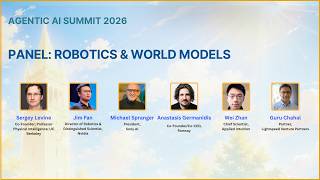 #026Panel: Robotics & World ModelsGermanidis, Fan, Levine, Spranger, Zhan
 #059World Models for Physical AI SimulationSanja Fidler, University of Toronto
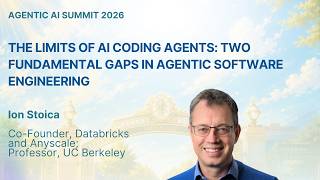 #063The Limits of AI Coding AgentsIon Stoica, UC Berkeley / Databricks
 #084Trustworthy Agents in the Real WorldVincent Vanhoucke, Waymo
 #087Scaling Sidewalk Autonomy with World ModelsBolei Zhou, UCLA / Coco Robotics
8 of 11 talks shown — the ones that reach the most concepts in this theme. Every sighting, per talk, is on the concept pages above.