
Concept register · Concept 61 of 64 · Theme: world models and embodiment Reviewed 2026-09-01
assay · concepts · world-models-and-embodiment
Embodied agents
Agents that perceive and act in the physical world hit constraints software agents share but rarely name, and the embodied lane has gone further in naming them. Two show up here: perception of change, and social transparency about intent and provenance. The transferable claim in both cases is that a capability nobody measured is a capability nobody has.
corroborated · assay: watching
3 independent sources · sighted at the Agentic AI Summit 2026 · last reviewed 2026-09-01
§1What it is
Vision models are bad at comparison
A standard single-image encoder cannot look back and forth between two inputs, so genuinely different images can receive identical descriptions. The fix was architectural rather than scale: a stateful encoder with cross-image attention in its middle layers — “so simple you’d be surprised it’s novel” — which wins on medical report generation, image-edit control, geospatial change detection and UI-state checks.
Named gaps move; unnamed ones do not
Spatial cognition went from near-chance two years ago to roughly three-year-old-human level within about two years, with perspective-taking near 100% on top models — and it moved once benchmarks named the gap. Weight-probing shows models that cannot generate images still internally reconstruct rotations, and supervising that internal capability improves downstream performance.
Social transparency is a capability, not a finish
For an agent operating in space shared with people, narrating intent and provenance mid-task — who asked for this, and why — can unlock useful work sooner than additional physical capability. The bet on display is that socially smart, physically mediocre robots are useful now, which reframes conversational competence as a capability rather than a UX polish item.
§2Sightings
Agentic AI Summit 2026 · 3 sightings
 #085Real World Reasoning AgentsTrevor Darrell, UC Berkeley / BAIR
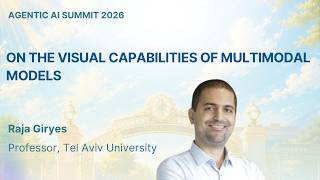 #104On the Visual Capabilities of Multimodal ModelsRaja Giryes, Tel Aviv University
 #054Startup Spotlight: Ludo RoboticsLudo Robotics
Also: BabyVision; the T-Rex tactile dataset; Sharpa hands.
§3Where Assay stands
Provenance is structural here, not conversational
Assay stamps who raised an item, links the work that produced a brief, and posts under the identity of the role that acted — so “who asked for this and why” is answerable from the artifact without an agent having to say it. That is the same property the robot demonstrates, reached by a different route, and it is the reason Assay can afford desks that run silent: the provenance lives in the record rather than in narration a human has to be present for.
The perception finding is the sharper one
Reviewer and verifier roles depend on exactly the capability shown to be weak — detecting a small change between two states. The implication is that comparison must be architected rather than assumed: present old and new state together in one context rather than relying on two sequential independent reads. A diff-based review already does this; a “read the file, then read it again” pattern does not. The narrower consequence is that a vision model should not be trusted as the judge of a rendered result — numeric verification first, which is already the rule here, now with an external reason attached.
§4Watch
- Whether the stateful-encoder result is picked up by any production harness for change detection, which is the mechanism most directly useful to a verifier role.
- Whether spatial and comparison benchmarks keep moving on the name-the-gap-then-patch cadence, or plateau — the current trajectory is two data points.
- Whether social and provenance transparency appears in a second embodied deployment; it currently rests on one startup demo.