
Concept register · Concept 28 of 64 · Theme: isolation beats instruction Reviewed 2026-09-01
assay · concepts · isolation-beats-instruction
Accountable delegation
Delegating work to an agent is not the same act as calling a tool. A tool call has a bounded contract and a ground-truth answer; a delegation transfers control to another autonomous loop that may clarify, stall, resume, or never return cleanly. Accountability does not transfer with the work — a computer cannot be jailed, embarrassed or fired — so the mechanism society actually uses assumes a socially exposed human at the end of the chain.
corroborated · assay: design rationale, shipped
3 independent sources · sighted at the Agentic AI Summit 2026 · last reviewed 2026-09-01
§1What it is
Delegation is not a tool call
The distinction has a governance consequence rather than a merely architectural one. All the orchestration patterns — handoff, agents-as-tools, router — reduce to one runtime decision: who handles this work, in this context. And several delegates can each be validly correct. “Play some jazz” is correctly served by the media API or by tapping the on-screen playlist, differing only in cost, latency and interaction, with a computer-use agent as a peer target. Multiple valid answers is the normal case here, not an evaluation failure — which means scoring a delegation decision against one expected label is a category error.
The Good Regulator constraint
Accounting is in the numbers; accountability is in human authority and judgment. The 1970 Good Regulator Theorem applies as a hard constraint rather than a metaphor: delegating to a model too large to understand violates it structurally. The accountable human can only be accountable while holding a workable model of the delegatee — and the delegatee needs a model of the delegator in order to know when to surface a problem. Wiring in agents nobody understands therefore produces sign-off theater; being handed an opaque system to sign off is, in the demand-side evidence, “absolutely disastrous.”
Agentic debt
The cost has a name worth adopting: the delegated-authority analogue of technical debt, paid later by whoever has to explain what the system did. It accrues quietly, on exactly the work that looked cheapest to hand over. Beyond the single-principal case lies the multi-principal frontier — agents representing different owners, with different goals, information asymmetry and some adversaries, finding counterparties and enforcing agreements without human intermediaries — where the affordances stop having human analogues altogether.
§2Sightings
Agentic AI Summit 2026 · 3 sightings
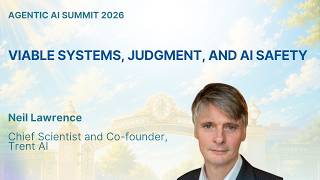 #124Viable Systems, Judgment, and AI SafetyNeil Lawrence
 #140From Multi Agent Patterns to Reliable OrchestrationDaniel Homola, BMW Research
 #123A Society of AgentsAlex Obadia, ARIA
Also: the Good Regulator Theorem (Conant and Ashby, 1970); the ARIA Scaling Trust programme.
§3Where Assay stands
The cleanest statement of why Assay is shaped this way
This is design rationale rather than new work, and Assay should claim it as such. Briefs are self-contained so the delegating human holds a good model of what was delegated. Desk verbs are narrow so the delegatee’s behaviour stays model-able. Evidence rows exist so the signing human is not approving accounts they cannot read. And the escalation vocabulary — question, help wanted, needs-decision — is the delegatee-to-delegator channel the bidirectionality argument requires; each of those labels demands a comment stating what is needed, which is what makes surfacing usable rather than a flag on a pile.
Why the human merge gate is not a throughput bug
The Good Regulator constraint explains a rule that otherwise reads as caution. The merge gate is the point at which an accountable person is still able to hold a model of what they are signing; widening it past that point does not speed the system up, it moves the cost. “Agentic debt” is worth adopting into the working vocabulary for a merged-but-unreviewed agent change — the board already carries the phenomenon under other names, such as merged-but-unflipped rows and stale verification, and naming it makes the cost legible.
The seam it lands on
A desk verb is a bounded tool call; dispatching a brief is an unbounded delegation. That is exactly why dispatches are wrapped in durable claims, Verify rows and a human merge gate rather than trusted return values. Intake routing is the same decision described above and will have several valid answers, so evaluating it against a single expected disposition would be the category error. Multi-principal trust is out of scope — Assay’s desks are single-principal and the accountable human is one person — but two things carry over anyway: an open adversarial testbed is the purple-team exercise the guard layer has never had, and enclave-enforced data-handling commitments would matter the moment desks exchange sensitive context across a trust boundary.
§4Watch
- Whether “agentic debt” is picked up as shared vocabulary. The concept currently rests mainly on one source, and a second independent framing would move it up the ladder.
- Whether anyone builds evaluation for delegation decisions that tolerates multiple valid answers rather than scoring against one label.
- Whether the ARIA programme’s testbed produces reusable adversarial scenarios a single-principal team could run against its own agent fleet.